

Math Monday: Counting - Part 2 - Rows/Rounds
Last week we took a look at counting stitches. This week we’ll be counting rows and rounds.
Before I start, I must say, this took me FOREVER to figure out. As much as it’s just counting, to me, it was always a question of whether you count what you see or you count some things you don’t see. I’ll explain. For purposes of the discussion, I’ll refer to rows (and not rounds) and then touch on special “round only” situations.

Cast-on row
Let’s begin at the beginning with the cast-on row. The cast on actually creates stitches. You can see them here, but this row does not count in your total number of rows. When instructions say, “Cast on 90 stitches and work 20 rows” it means just that. Do not be fooled into thinking that you only have to work 19 rows because the cast-on counts as a row. If you look carefully at where my finger is pointing, it looks like there are 2 Vs, but only 1 row has been worked. The first V is really the stitch formed on the cast-on. Again, do not count this V as a row!

The cast-on row and one knit row. Although 2 Vs appear, only 1 row has been worked.
The stitches that are looped on the needle do not count as a row. They are waiting to be worked into the next row.

Stockinette Stitch - 4 rows worked.
In the picture above, you can see 4 Vs (count vertically up the column of stitches between the red lines). The blue bar indicates the cast-on V which now fades into the background.
A little double check I use with Stockinette stitch is to remember that usually Row 1 is a knit row, and Row 2 is a purl row. This means that all the knit rows will be odd rows and all the purl rows will be even rows. In the picture above, you can see that I’m about to begin a knit row since the yarn is coming from the right. That means I’ve just completed an even (purl) row. Since 4 is an even number, I know that I’ve counted correctly. This also works with reverse Stockinette stitch, just remember that in this case, the purls are odd and the knits are even.

Right side

Wrong side
With garter stitch each ridge counts as 2 rows worked. However, sometimes, one side will have one fewer ridges than the other as in the two pictures above. If this is the case, then you have worked an odd number of rows. If both sides have the same number of ridges, you’ve worked an even number of rows. So, for example, if you have 5 ridges on one side and 4 ridges on the other, you’ve worked 9 rows. If you have 5 ridges on both sides, you’ll know you’ve worked 10 rows.
In garter stitch, though, be very careful. On one side of the work, the cast-on will appear to be a ridge.
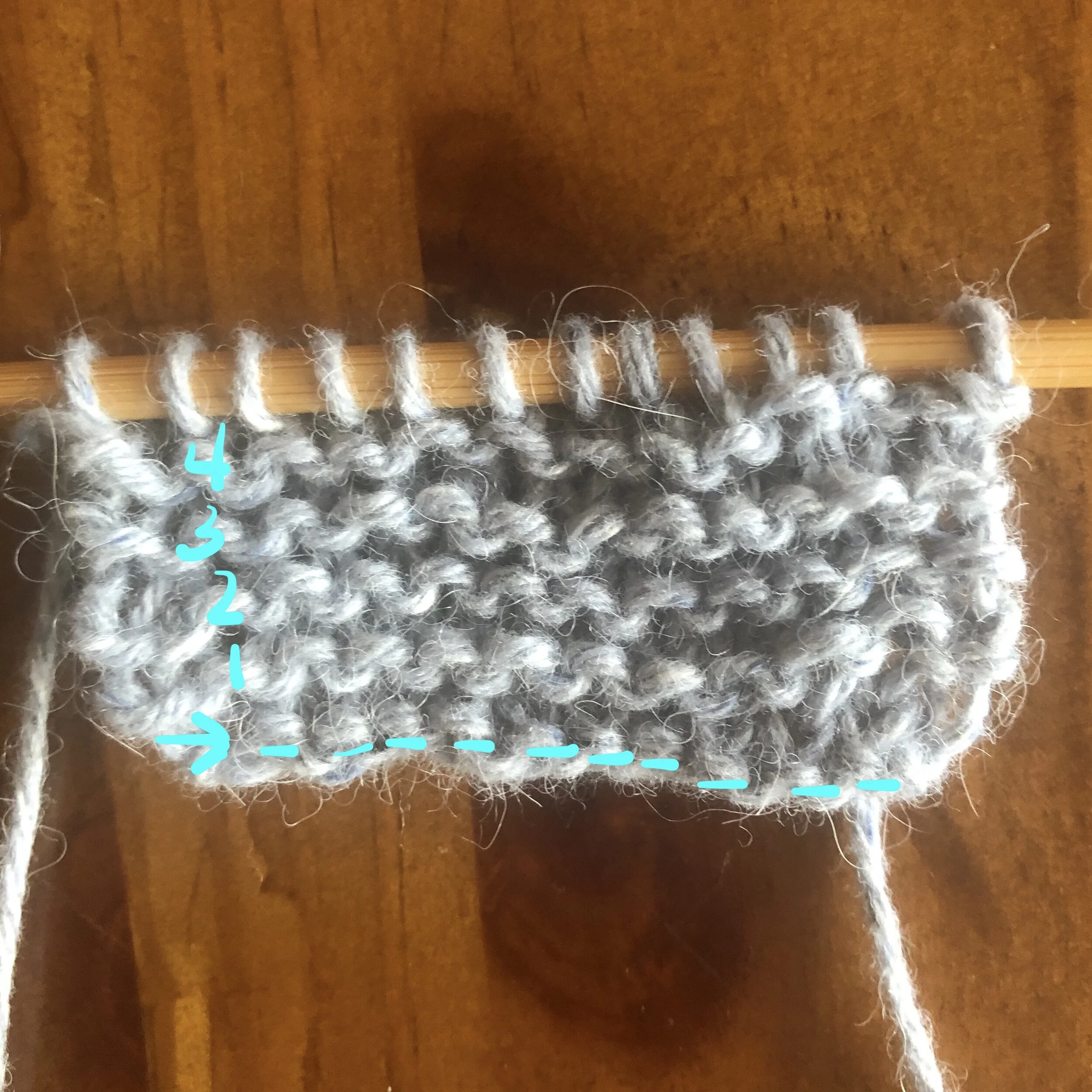
Only 4 ridges here!
In the image above, the arrow points to a ridge of stitches which is really the cast-on. There are really only 4 ridges. Do NOT be fooled!
Finally, a discussion on rounds. Many times, you’re counting rounds as you complete them. If this is the case, just go ahead and count them the same way as you do for rows. However, if you’re like me, sometimes you’re counting rounds in the middle - either to check yourself (since there’s no right or wrong side) or to see how much longer you need to work for an increase or decrease. If that’s the case, know WHY. Do you want to know how many you’ve completed or do you want to know which round you’re working on?
If you want to know how many you’ve completed, count the rounds to the LEFT of you’re working yarn. If you want to know which round you’re working, count the rounds to the RIGHT of you’re working yarn.

Math Monday: Increasing - Part I - along the length
A few Mondays ago, I discussed decreasing along the length of knitted fabric, and we did the calculations. Today, we’re going to do the same thing for increasing. You can read that here (in fact it might be useful if you did before you begin reading this one.)
The sleeve of Ledbetter is worked from cuff to underarm with a modified drop shoulder shaping to eliminate bulk at the underarm.
This works the exact same way, so let’s review using a new sweater that I’ll be publishing in the late summer/early fall, Ledbetter. Ledbetter’s sleeves are worked in the round from the cuff to the upper arm and then seamed onto the body. The sleeve is mostly worked in Stockinette stitch but it starts with a bit of the textured pattern - 1.5” [4cm]. The length of the entire sleeve with the cuff is 16.5” [42cm], but I’ll only be doing the increasing over the stockinette portion of the sleeve, not the cuff. That’s 15” [38cm].. As I wrote when we discussed decreasing, it’s never a good idea to immediately begin decreasing or increasing on the first row/round, and it’s never good to end them on the last row/round either. I usually begin and end with 1” [2.5cm] at the beginning and end worked even.
So, if we take out the 1.5” for the cuff and the 1” at the top and bottom the sleeve (2” total), we are left with 13” (16.5 - 1.5 - 2 = 13”). At a Stockinette row gauge of 6.75 rounds per inch, that leaves us with approximately 88 rounds with which to work {13 x 6.75 = 87.75 - I always round to the nearest even number}.
For Size 2, the cuff begins with 40 sts (9” x 4.25 sts/inch - rounded to the nearest 4 sts) and the upper arm ends with 60 sts (15” x 4 sts/inch), which means I need to increase 20 sts. Remember, these stitches are worked in sets - one at the beginning of the round, one at the end of the round. I’ll need 10 sets of 2 stitches each totaling 20 sts. However, I’ll do the very first set on the very first round since I’ve already left 1” before I’ve started the decreases I won’t need to leave more. This now brings the total down to 9 sets of decreases over 87 rounds.
I do the math just like I did for decreasing:

With this set up, you can see that you’ll have to do a increase every 9th round 3 times and every 10th round 6 times. You can decide how you’d like to set this up - you could do it as it’s laid out or you could do *every 10th round 2 times and then every 9th round once and then repeat from * twice more. All your increases will be evenly placed along that sleeve!
Of course, if you want to shorten or lengthen your sleeve, with this formula, it’s easy to do. You’ll still need the same number of increase sets (your divisor), but your dividend will change. You can use math to evenly space out your increases every time.
And this has other uses besides sleeves. You can add body shaping (waist to bust shaping (bottom up) or bust to waist (top down). for example. Or you can use this to modify a front or back neck depth or adjust an armhole.
A few thoughts before we finish…
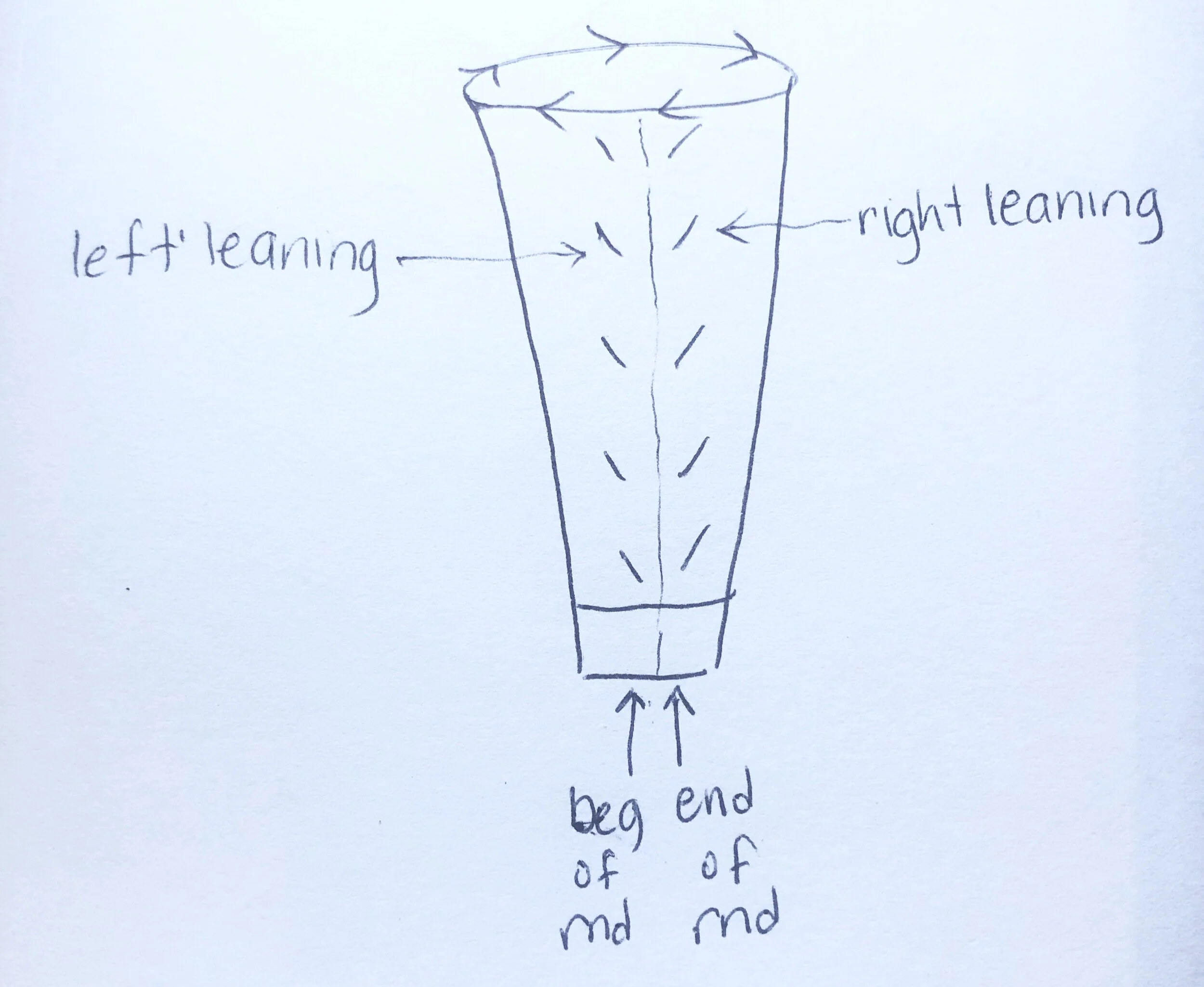
Just like with decreasing, increases should never be placed at the very beginning or end of the row or the round. If you’re working in rows, it will be difficult to seam. If you’re working in rounds, the stitches will be distorted at the “seam line.” I usually place mine 2 stitches after the start of the row/round and 2 stitches before I end the row/round.
Another hint to make your knits aesthetically pleasing is to be sure your increases “lean” the way your sweater is growing. For example, in this sweater, the sleeve is being worked from the cuff up to the underarm, growing in circumference. Therefore, the increases at the beginning of the round should lean left and the ones at the end should lean right.
Using math to make adjustments to your knitting in this way will help you customize your garments for a more perfect fit.