
Designer Insider: The Submission Process
On IG last week, some of you asked me to share a little bit about the process for submitting a design to a publication. Typically the start of the whole thing begins with the publication putting out a “call” which includes a description of the theme of the issue, in this case, “inside nature,” as well as what types of pieces they’re looking for - garments and accessories (sometimes there’s a specific number of each), a mood board and a deadline for submissions. Sometimes the call includes submissions for articles and stories on the theme.

The submission for Making Stories Magazine, Issue 5, published March 2021. You can see the finished Twisted Vines sweater on Ravelry here.
This is my submission for Making Stories - Issue 5 - Inside Nature. The editor, Hanna Lisa, is really generous with her submission timeline, providing at least a month or more, and sending out reminders. Other publications give only a few weeks.
My submissions always have 6 parts: inspiration photo(s), a sketch, a description, swatch photo(s), swatch information, as well as contact information and the heading. Each part is crucial to putting together a strong submission.

THE INSPIRATION: I keep private and public Pinterest boards with lots of inspiration. I have boards with designer knitwear, architecture, art, nature, poetry, quotes, - lots of different kinds of things. There is always something to inspire me, although it can be difficult to come up with an idea that fits the theme of the publication and is seasonally appropriate. In this case, I had these pictures of old trees with gnarled branches and vines crawling up them. They reminded me of cables and I wanted to add twisted stitches to them to mimic these trees.. I ended up only putting 2 of these photos in the actual submission.

My original sketch included a patterned back panel, which didn’t make the final cut.
THE SKETCH: With a complex stitch pattern I knew I wanted to keep things simple by highlighting only one special detail - the sleeves. I thought to maximize that detail, I would try out a saddle shoulder. This would extend the length of patterning and make a bigger impact. I had never designed a saddle shoulder sweater before, but I often don’t let things like that stop me. I had knit one, so I knew I could design one. I use a croquis that I drew years ago to keep things simple. I make copies of the croquis and then layer on the knits. I’ve found that using the croquis helps me concentrate on the sweater without worrying about the proportions of the body. You can see she’s kind of faceless, too. Faces cause distractions.

I also did a Stockinette stitch swatch. That’s important as most of the sweater is Stockinette.
THE SWATCH: Now it was time to swatch. I love DK weight yarn and the one I used for this is a blend of cotton and wool - The Plucky Knitter Crew. I love it. It was a deep, forest-y green that I thought fit the call, and the yarn has a tight twist which makes the stitch definition really good. The blend of cotton and wool, which takes the dye differently, gave it a subtle shift of color, but didn’t detract from the cabling. I also knew the cable pattern I used had to be intricate, but couldn’t be an unreasonable number of rows. I had to get a good number of repeats in the length of the sleeve. I also knew I wanted to pair a complicated cable with a simpler one at each side. After trying out a few different stitch patterns, I decided on this one. After knitting the swatch, I washed, blocked, and photographed it. I did the same with a Stockinette stitch swatch.
SWATCH INFORMATION: It’s important to the editors to know what yarn you used even if they’re not going to use it in the publication itself. Yarn affects everything: size, drape, stitch definition, choices of color, etc. So I always include the name of the yarn, yarn composition, the color I’ve used, the needle I’ve used to knit each swatch and the stitch and row gauge for each swatch I’ve included.
DESCRIPTION: I now spend some time thinking about how I would need to knit the garment or accessory in order to “bring it to life.” I always think first of whether I can knit a garment top down and if it can be knitted seamlessly, as this is the way most knitters want to knit. However, sometimes an idea will be overly and unnecessarily complicated by doing it this way. I find simpler is always better and there are times when a design needs to be knitted bottom up or with seams for just that reason. For accessories, I usually just think about how I want to knit it. After I give these things some thought, I write out a sequence of knitting steps: first, second, third, etc. involved. Once these thing are done, I write my description. I like to do a combination of aesthetics with practical construction details, along with some suggestions for the yarn to use.
HEADING AND CONTACT INFORMATION: You might think this isn’t critical, but it is. I always include the name of the publication, the issue and the theme of the issue and I always name my designs. It makes the submission more special. It’s also crucial to include your contact information in case your submission gets separated from the email you sent. I always include my physical address and phone number because the publication will need that when they arrange for your yarn to be shipped out to you. (You can’t see those in the image because I’ve blocked them out!) Finally, I make sure there are links to my Ravelry design page and my website so the editors can check out my work if they’re unfamiliar with it.
If you’ve gotten all the way through this, I’d love to hear from you - especially if you design too or are planning to design. Tell me what your process is.

Fudge Friday: Whatsa matter, yoke?

Riparia, with it’s floral yoke was ultimately a fun design that taught me quite a bit.
You might know there are a few ways to construct a yoke sweater. What’s a yoke you may ask? It’s a sweater in which the part above the armholes looks somewhat like a cone.

This is the schematic for Riparia, a yoke pullover. It’s upside down on purpose - because it’s worked from the top down.
When a yoke pullover is worked from the bottom up, 3 tubes are constructed are constructed first - the body and both sleeves. They are then joined and the yoke is completed with decreases to the neck, circularly in one piece.
Riparia is constructed from the top down, meaning that first the yoke is constructed - with increases, then the yoke is separated into 3 parts - body and sleeves - and then the pullover is finished by knitting 3 tubes.
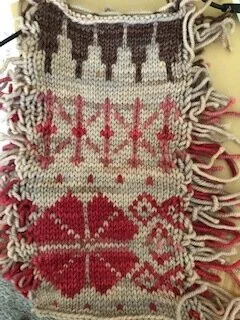
Swatching for Riparia.
Now you can insert those yoke increases (or decreases) in a couple of ways, but the only way I knew about was the way I learned: increase between solid resting rows. In the swatch above, you can see the grayish taupe solid rows were where I inserted the increases.
However, you can also see that the pattern is not centered. When you get to the flower, it looks off.
So I wrote the pattern and handed it off to a sample knitter - not something I usually do. She wrote back to tell me it looked off, although the stitch counts worked. Enter my tech editor.
With one look, she told me I’d have to create wedge increases. What’s that you say? Think of a pie and then mark the slices. This is what wedge increases create. Instead of putting all the decreases you need in one round, you put them in in each wedge, like this:
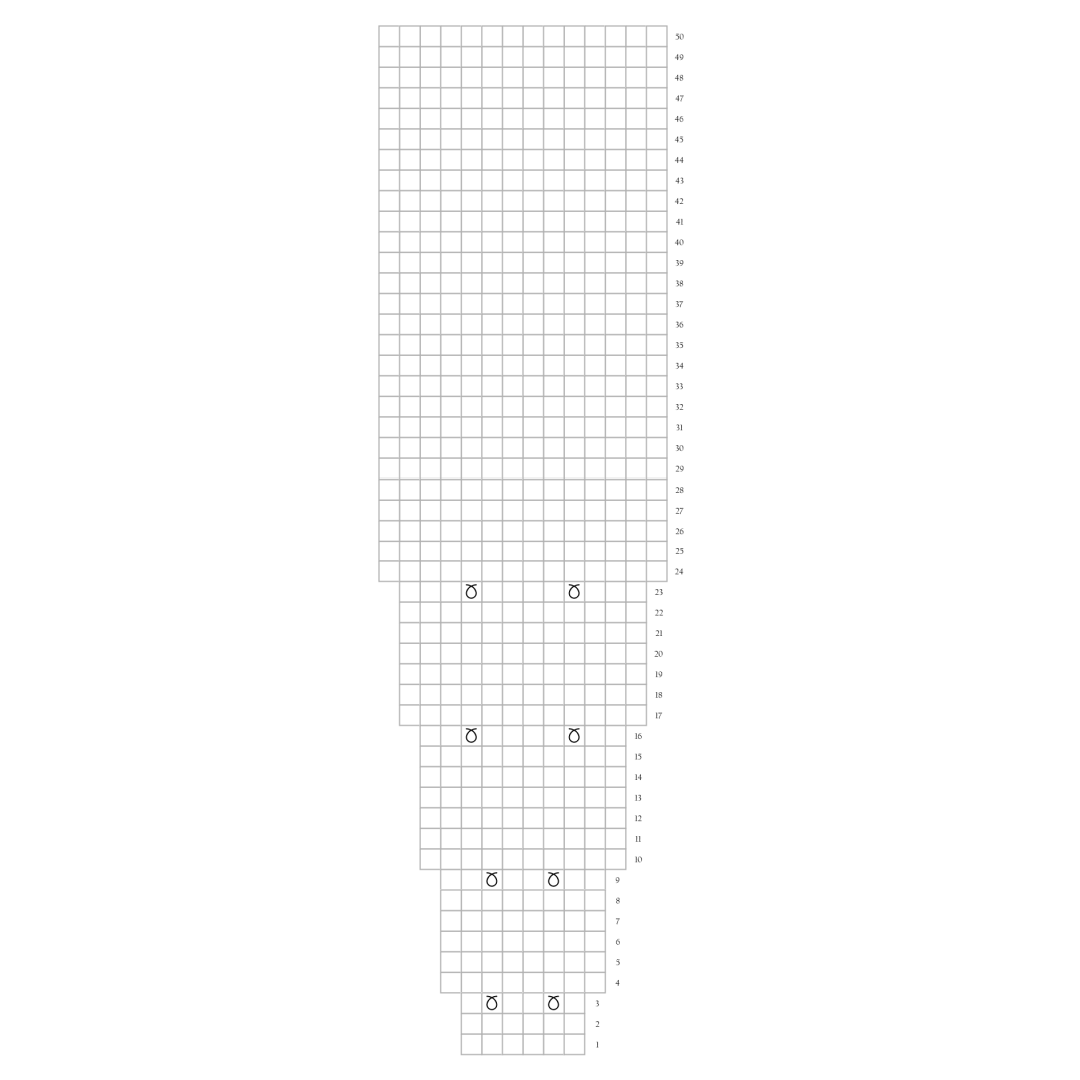
Here’s the wedge representing one pattern repeat. The curls indicate increase placement and the wedge grows from 6 sts to 14 sts.
The stacked motifs are always centered in a wedge yoke design.
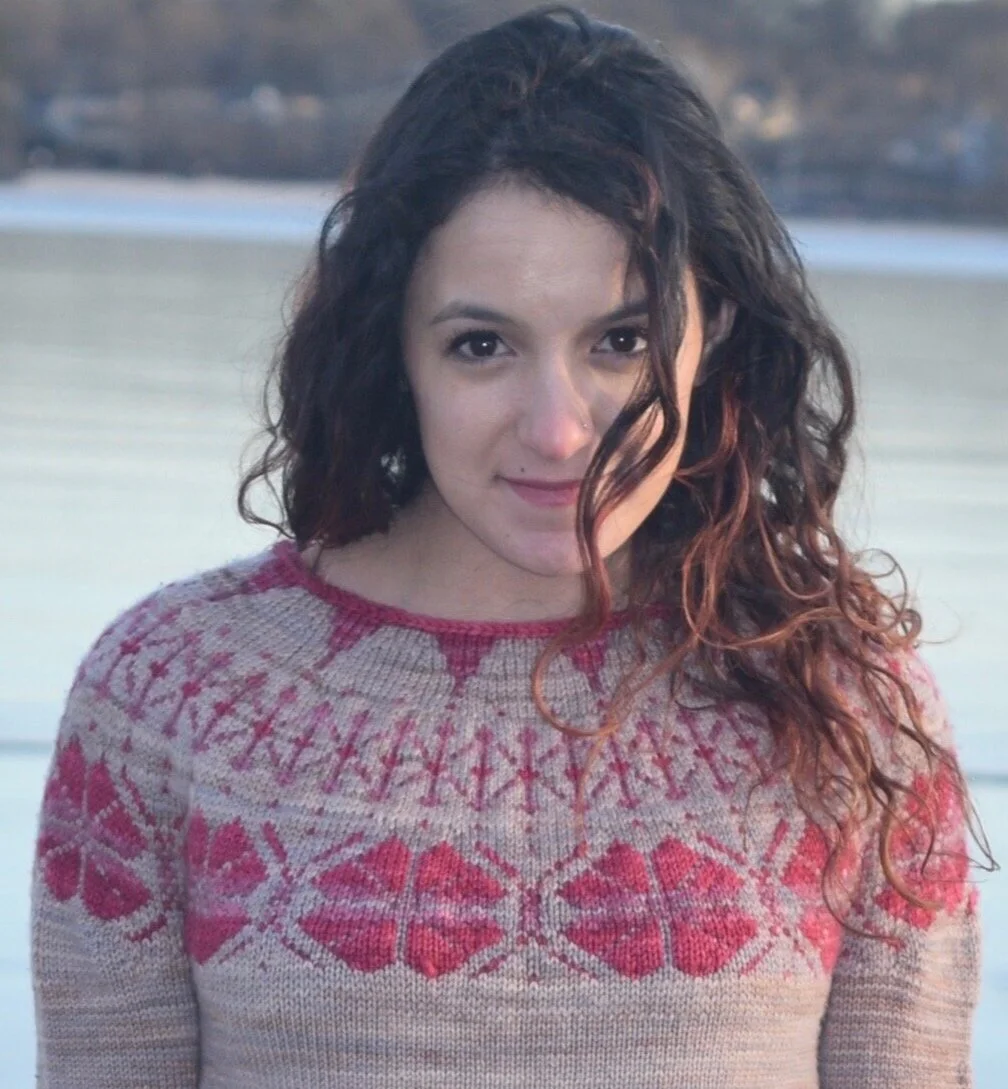
Here you can see that the yoke motifs are now centered as they are stacked.
I love how Riparia turned out, but it was a long road to get there. The good news was that I learned that there’s more than one way to construct a yoke.
Math Monday: Decreasing - Part I - along the length
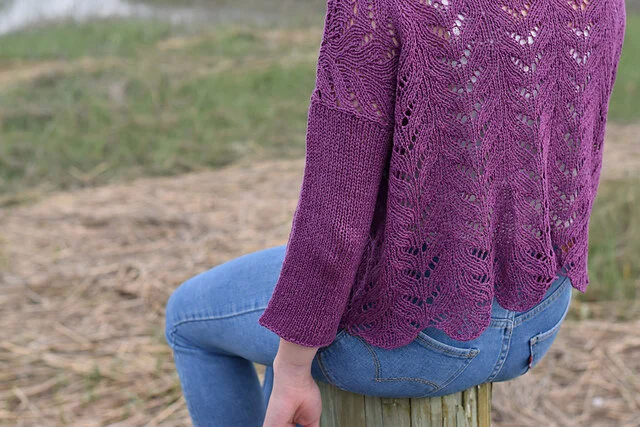
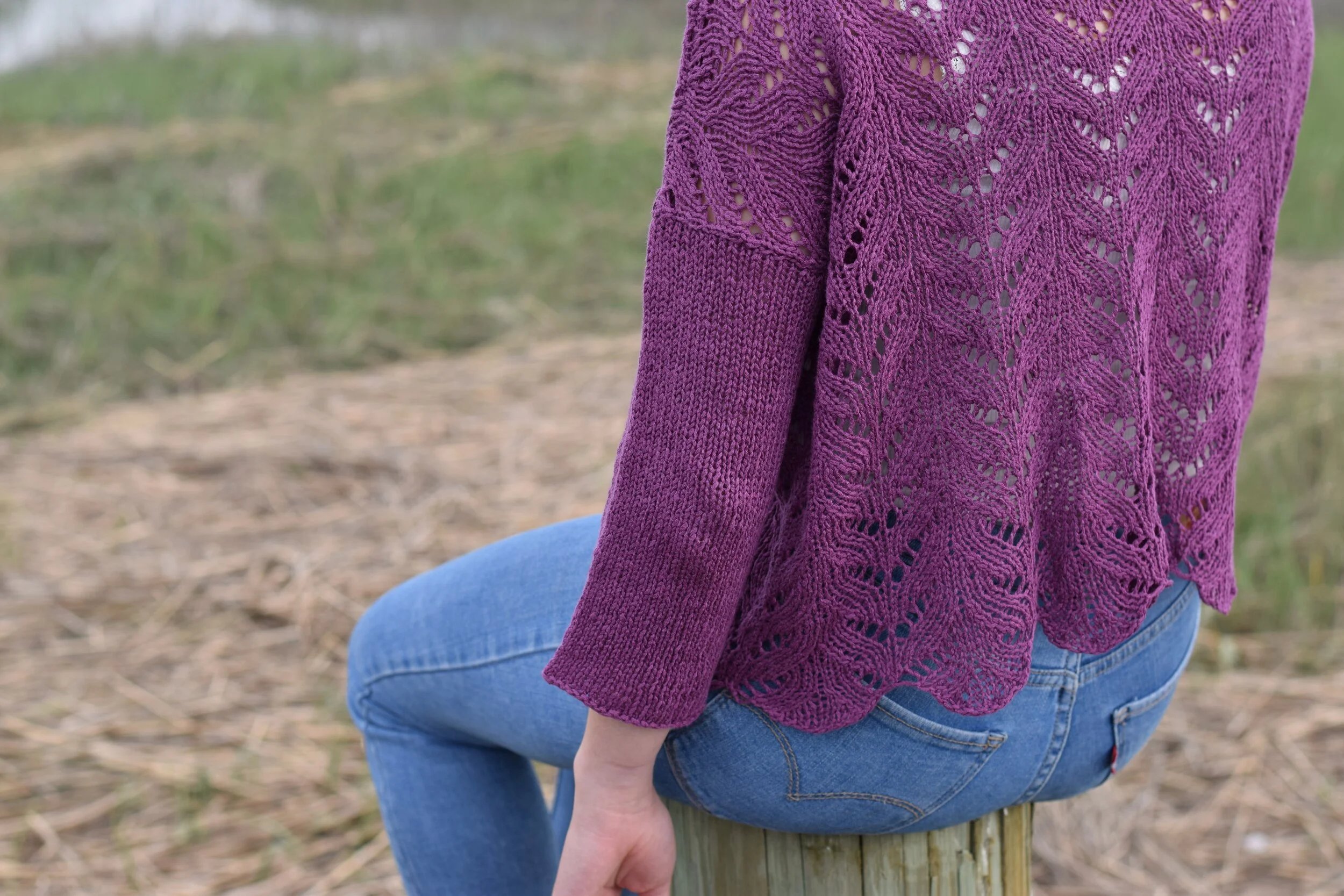
This is Enracine, a cool linen top from 2020.
Long division. Do you remember?
This Monday, I’ll be teaching you how to use long division to calculate decreases —one that is used to taper a sleeve or the body of a sweater. Next week we’ll use it for decreases along a row or round.

Sleeve schematic for Enracine
There are 3 measurements you’ll need to calculate this type of decrease: a starting point (E), an ending point (G) and the length over which you’d like the decreases to occur (F). Of course, you’ll also need your stitch and row gauge.
In the sample size, the starting point circumference was 13” [33cm]. If we multiply this number by our stitch gauge of 4.75 sts/inch, we know that our starting point stitch count is 62 sts - rounded to the nearest even number. Our ending point circumference is 9.5” [24cm]. If we multiply this number by by our stitch gauge, we know that our ending stitch count is 46 sts - again, rounded to the nearest even number. By the way, it doesn’t have to be even, but both numbers have to be the same - both odd or both even.
The difference between 62 and 46 is 16 sts, and we need to do these decreases in sets, one on each side of the “seam line” of the sleeve. This means there are 8 sets of decrease points along the sleeve for this size (16 divided by 2).

The decreases occur at the inside of the sleeve.
Now for this design, I wanted three-quarter sleeves, so the length of the sleeve for all sizes is 9.5” [24cm]. They seem shorter than normal because this design was a drop shoulder. We’ll discuss that another time. The row gauge is 8.25 rounds per inch as the sleeves are knitted in the round. It works the same way for pieces knitted flat. Decreases shouldn’t start at the first round of the piece and shouldn’t end on the last round either, so the rule of thumb is usually to leave 1” [2.5cm] at the top and bottom before the first and after the last decrease. This reduces our length by 2” [5cm]. Now we only have 7.5” [19cm] to work with.
Multiply 7.5” by our row gauge of 8.25 gives us approximately 60 rounds to work with.
Now comes the long division:

Follow the steps beginning at the top left.
Only 1 more step and we’re done!

Draw arrows that cross from the quotient and the quotient + 1 to the remainder and the difference between the divisor and remainder. This tells you that to get evenly spaced decreases, you work a set of decreases every 7th round 4 times, and every 8th round 4 times. You can alternate these - every 7th, then every 8th, then every 7th…. - or you can just work decreases every 8th round 4 times, then every 7th round 4 times.
You can also do a little math check if you want to prove to yourself it works:

Multiply number of rounds to decrease by number of times to check your answer! IT WORKS !
Now isn’t math awesome?

Fudge Friday: Distractions
We’re back to Fudge Fridays where I confess my knitting mess ups.
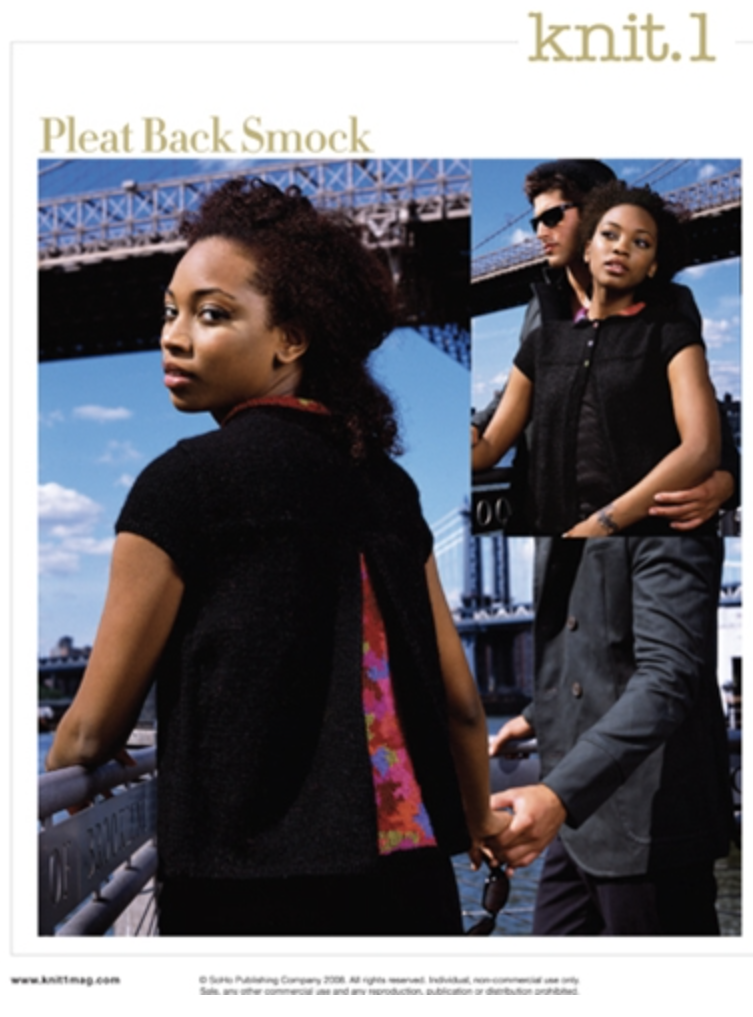
This design was a take on an artist’s smock. I loved this little cardigan. It had three buttons up top and flared open. On the back was a pleat with an “artist’s palette” with 10 different colors of yarn, knit in intarsia.
I designed the cardi for Knit.1 magazine, a funky little publication now out of print, to be knit in pieces from the bottom up. I was on a tight deadline (as always), but had written the pattern. I started with the back. The pleat was dead center of the back and as it went up to the neck, stitches were decreased on each side (in black).
I confess, I was watching a baseball game (my team, the Yankees - I was born in the Bronx) and my husband was talking to me. I shouldn’t have been anywhere near anyone for the set up, at least, but…you guessed it: I miscalculated and the pleat wasn’t centered.
It wouldn’t have been that bad if I only had to take out the cast on, but I was at the underarm before I realized it!
ALL THAT RIPPING IN 10 DIFFERENT COLORS! I was so upset that I had wasted all that time and now the deadline was even tighter. But, in the end, it turned out perfectly. It’s still one of my favorite pieces.

Lesson: Pay attention to the set up!
The Pleat Back Smock pattern is available from the Vogue Knitting store here.

Math Monday: Mystery Yarn - The Adventure Begins
Way back in a far away time that seems eons ago (October 2017) my good friend Lee and I went to Rhinebeck, otherwise known as the NYS Sheep and Wool Festival, and not for the first time. Up to that point, we had gone every year for a good many years. For a bunch of reasons, we haven’t been back since, but once this is all over…
As we trolled through the outside buildings on a warm autumn day we came across the Harrisville Designs’ booth. Besides having their own great yarns, Harrisville also does custom spinning for a number of other well-known brands of yarn. We stopped in our tracks when we saw that they were launching n I g h t s h a d e s and spent awhile admiring it. I bought a sweater’s quantity of their lovely WATERshed. Lee kept looking. And then she called me over to the sale bin.
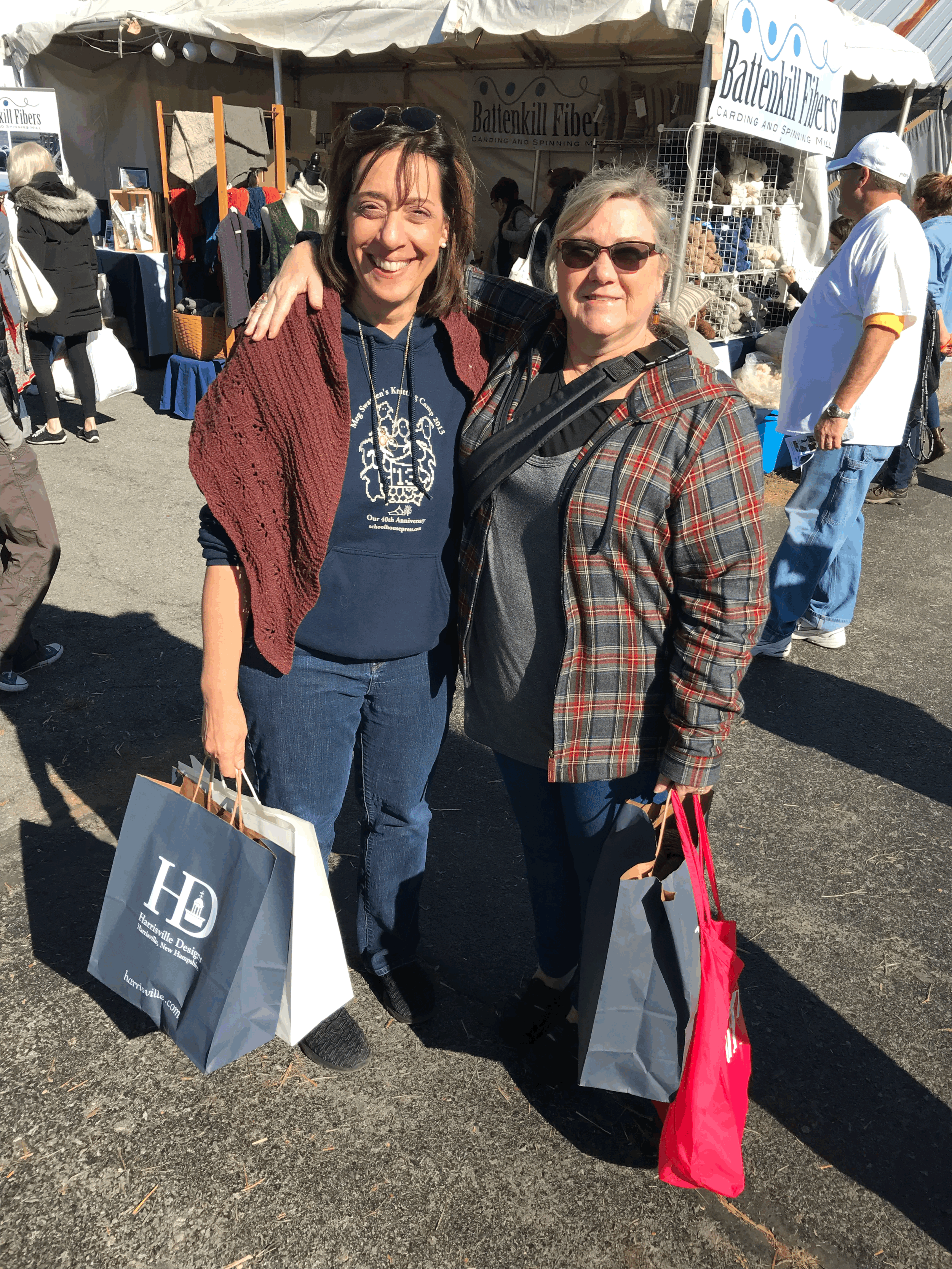
See our Harrisville bags?
Inside was a rustic two-ply wool that was unlabeled. We asked about it, but the only thing the kind Harrisville lady told us was that it was a mill end and that it was 100% wool. Harrisville spins for Brooklyn Tweed, We were both a little smitten. Lee bought 5 skeins. I bought the remaining 3. Occasionally, Lee or I would talk about the yarn, yet neither of us ever did anything with it.

All 8 skeins nestled together!
Fast forward to January 2021. I was doing my semi-annual stash purge and once again came across this yarn. I was still in love. Now you should know that I never to design with any yarn that is discontinued or that I know will be, and certainly never with homespun or an unknown yarn. But this yarn was calling out to be a textured pullover. My 3 skeins wouldn’t do it. So I called Lee, asked her if we could trade - she gave it to me - and it started. The pullover is done, but not yet released.
Over the next few Mondays, I’m going to be writing in this space about yardage. We’ll be estimating and calculating. Yes, it’s math, but don’t be scared! It’s not trigonometry and it’s really rather simple. How will it help you, the knitter? You can calculate yardage you’ve used or how much you need, or how much you’d need if you change an element in your own knitting - like making short sleeves instead of long, or lengthening the body of a sweater. Or perhaps you have your own mystery yarn and want to know if you have enough? Once we’re through, we’ll figure out how we can estimate yarn weight based on yardage.

Analyze this!